On October 29, Uniswap launched a new feature: TJAR (Token Jar).
Readers familiar with the UNI burn mechanism may not be strangers to it, because Uniswap has already been using this mechanism to handle protocol fees.
This time, Uniswap has opened TJAR up for other applications to use.
Robinhood has also started integrating, collecting trading fees through the Uniswap API.
So what exactly is TJAR? What problem does it solve? And what impact will it have on UNI?
1 | Where Did TJAR Come From?
TJAR is not a brand-new technology.
It was originally designed for Uniswap's own protocol fee conversion.
In the past, when Uniswap collected protocol fees, it might receive different kinds of tokens. To convert them uniformly into UNI and use them for burns, a dedicated conversion mechanism was needed.
TJAR was built for exactly this.
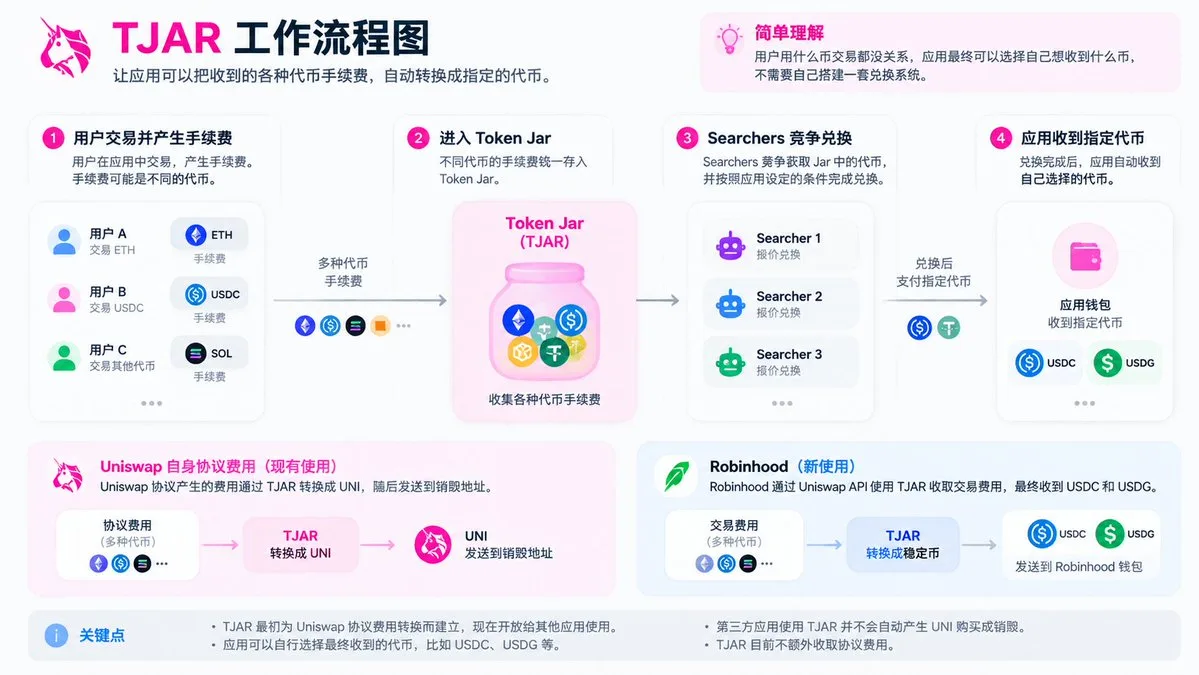
It can collect different tokens in one place, complete the swaps through searcher competition, and finally send the designated token to the designated address.
According to Uniswap's officially published data, the original Token Jar system processed over $15.3 million in token conversions in the past month.
On October 29, Uniswap opened this mechanism to other applications, with support for seven blockchains.
2 | How Does TJAR Work?
Take Uniswap itself as an example: it handles tens of thousands of trades every day, and every trade pays a fee.
When users trade ETH, it receives ETH; when users trade USDC, it receives USDC.
Over time, a lot of different tokens pile up in the application's wallet.
But Uniswap may only want to ultimately receive UNI.
This is where TJAR helps it complete the process:
-
Fees in different tokens enter the Token Jar.
-
Searchers compete to swap these tokens.
-
Searchers complete the swaps according to the set conditions.
-
The application receives the token it designated.
This way, the application does not need to build its own fee swap system separately.
3 | Robinhood Is Already Using It
With this TJAR launch, Robinhood is one of the first publicly known applications using it.
According to Uniswap's official announcement, Robinhood is already using TJAR on supported chains to handle trading fees collected through the Uniswap API.
One detail is worth noting, though:
Robinhood ultimately receives USDC and USDG, not UNI.
Robinhood can use the fee conversion infrastructure provided by Uniswap while choosing its own settlement asset according to its needs.
This also shows that TJAR is not a tool built specifically for UNI burns - it is a general-purpose token fee conversion system.
4 | What Does TJAR Mean for the UNI Burn?
This is the question UNI holders care about more.
Two situations need to be distinguished:
1. Uniswap's own protocol fees
Qualifying protocol fees can be converted into UNI through TJAR and then sent to the burn address.
This was TJAR's original purpose.
2. Other applications using TJAR
Other applications can choose for themselves which token to ultimately receive.
Robinhood, for example, chose USDC and USDG.
Therefore, third-party applications using TJAR does not automatically generate UNI purchases and burns.
Additionally, TJAR currently charges no extra protocol fee.
So you cannot simply assume that the more applications connect to TJAR, the larger the UNI burn must be.
5 | Summary
In short, TJAR was originally a tool Uniswap used to handle protocol fees and convert them into UNI; it is now opened up for other applications to use.
For Uniswap, this is an expansion of its infrastructure capabilities, letting other applications use its fee conversion system.
For UNI, the impact needs to be looked at case by case:
-
Conversions of Uniswap's own qualifying protocol fees can still be used for UNI burns.
-
Third-party applications using TJAR does not mean UNI burns will occur.
-
Growth in TJAR's usage scale is also not the same as synchronized growth in UNI's value capture.
In my view, what makes this upgrade most worth watching is not how much burn it brings to UNI, but how many applications will actually use this system in the future.
As for whether the growth of those applications can further convert into value for UNI, we still need to see Uniswap's subsequent fee mechanism and tokenomics design.
This article is personal research and educational sharing, and does not constitute investment advice. Discussion and corrections are welcome.